EDuke32 2.0 and Polymer! "talk about the wonders of EDuke32 and the new renderer"
#3867 Posted 12 June 2013 - 07:27 PM
Plagman, on 11 June 2013 - 07:37 PM, said:

Some parts of the texture are invisible, i.e. 0% opacity. And that part might be displayed if, for example, you are using the texture as a wall.
#3869 Posted 13 June 2013 - 02:27 AM
#3870 Posted 13 June 2013 - 05:33 PM
#3871 Posted 13 June 2013 - 06:10 PM
Plagman, on 12 June 2013 - 08:00 PM, said:
I want to have control of what is in the invisible parts...
===//===//===
Is it possible to include an orientation flag to display a tile as the skybox defined? It could work like showview, using <x1> <y1> <x2> <y2> to position it. The unusued values of rotatesprite would be used for angle, horiz and roll.
This post has been edited by Fox: 13 June 2013 - 07:20 PM
#3872 Posted 13 June 2013 - 10:53 PM
Fox, on 13 June 2013 - 06:10 PM, said:
You also have control over the invisible parts with a regular PNG image; there's still color data if alpha is 0.
#3873 Posted 14 June 2013 - 01:18 AM
In Photoshop, for TGA images the alpha channel is edited separately as a black and white channel... can't you set up the image program you're using to do the same?
#3874 Posted 14 June 2013 - 01:20 PM
Usage of DNCLIP cheat does not display confirmation message any more.
#3876 Posted 14 June 2013 - 09:10 PM
Plagman, on 13 June 2013 - 10:53 PM, said:
Unfortunately the image editing softwares don't seem to like it.
And it would not "just add bloat to the game code", it would help to organize the textures.
#3877 Posted 15 June 2013 - 10:24 AM
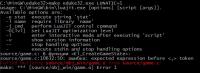
How to compile lunatic eduke with mingw?
I've installed mingw using manual from eduke wiki. It works ok and can compile common eduke32. Then I've complied LuaJIT 1.1.8 and put it in bin folder.
This is what I get when trying to compile lunatic with
make eduke32.exe LUNATIC=1
This post has been edited by fgsfds: 15 June 2013 - 11:52 PM
#3878 Posted 16 June 2013 - 02:50 AM
fgsfds, on 15 June 2013 - 10:24 AM, said:
I've installed mingw using manual from eduke wiki. It works ok and can compile common eduke32. Then I've complied LuaJIT 1.1.8 and put it in bin folder.
First, you'll need a fairly recent LuaJIT -- at least version 2.0.2 which was released two weeks ago. Major version 2 is required for features and the latest stable version because Lunatic (or some CON-to-Lua translated code, to be exact) exposed some bugs with its machine code generation [brag
However, beware if you want to start writing Lunatic code. The API is still unfinished and parts of it may change before the first public release.
#3879 Posted 21 June 2013 - 04:38 AM
So I was wondering, why can't the same be done for sector geometry? It looks a bit ugly when you make a nice smooth curve but the wall segments become extremely obvious due to light.
#3880 Posted 21 June 2013 - 05:05 AM
Smoothing is a shading interpolation between surfaces, which requires an external lightsource.
This post has been edited by Gambini: 21 June 2013 - 05:07 AM

#3881 Posted 21 June 2013 - 05:26 AM
#3882 Posted 21 June 2013 - 06:03 AM
#3883 Posted 21 June 2013 - 07:08 AM
You never know, plagman might stroll in here and go "oh yeah that's very easy" and we'll have it the next day.
#3884 Posted 21 June 2013 - 10:09 AM
#3885 Posted 21 June 2013 - 11:30 AM
#3886 Posted 21 June 2013 - 12:22 PM
Hendricks266, on 21 June 2013 - 11:30 AM, said:
A system like that is sorely needed, as well as being able to fade music in and out.
#3887 Posted 21 June 2013 - 12:34 PM
The new starttrack command should use two variables, the first one for episode and the second for the level. You would play and episode tracks with VOLUME+1, while zero would play the Title/Brifing/Loading tracks, and -1 would stop the current track from playing. It could be called startmusic, as a reference to the music command.
This post has been edited by Fox: 21 June 2013 - 02:09 PM
#3888 Posted 21 June 2013 - 04:14 PM
Gambini, on 21 June 2013 - 06:03 AM, said:
The sector walls shouldn't be shaded at all except by a light. Otherwise you're stuck with the gradient. If it looks broken up define a normal map for the texture.
#3889 Posted 21 June 2013 - 10:49 PM
#3890 Posted 22 June 2013 - 04:34 AM
Gambini, on 21 June 2013 - 06:03 AM, said:
Ehm, not really. Shade and polymer lighting are two completely different things. You could have smooth lighting and still shade walls manually. I don't think using shade as a basis for smoothing would be useful at all.
#3891 Posted 22 June 2013 - 07:12 AM
#3892 Posted 22 June 2013 - 09:51 AM
Gambini, on 22 June 2013 - 07:12 AM, said:
Yeah but on 100% Polymer stuff shade is basically the same on the whole map (pitch black, or just a slight ambient level). So using it for smoothing would be kinda doomed.
In Source, Quake, etc. compiling tools, you can define a maximum angle at which faces meet to apply smoothing on the resulting light maps, perhaps an adjustable setting for that in Polymer would work?
This post has been edited by Diaz: 22 June 2013 - 10:08 AM
#3893 Posted 22 June 2013 - 12:58 PM
#3894 Posted 22 June 2013 - 01:44 PM
Won't it work using the the angle difference as a reference? I.e. if the angle is 90º or more there won't be any smoothness at all, and if the angle is 0º then it will be 100% smooth.
This post has been edited by Fox: 22 June 2013 - 01:44 PM

Help
Duke4.net
DNF #1
Duke 3D #1